
Jute Fabric Specifications Explained: Yarn Counts, GSM, Weave & Grades
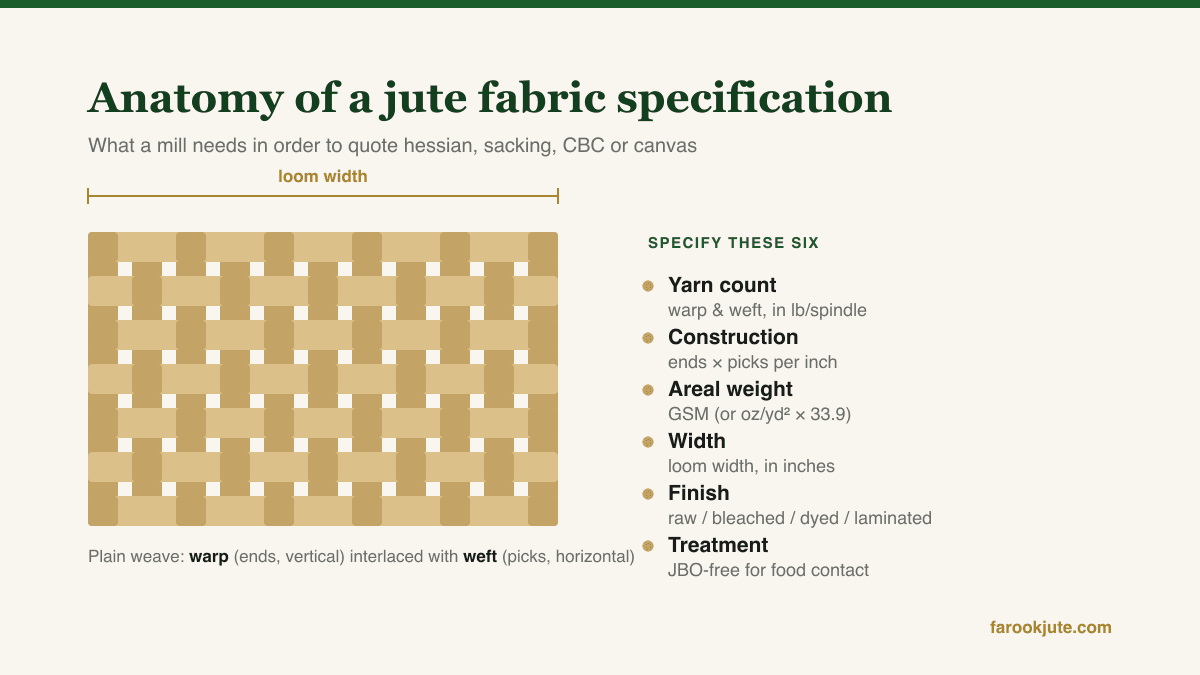
Most problems in a jute fabric order start with a vague enquiry. "Send me a quote for burlap" cannot be priced: a mill needs to know the yarn, the construction, the weight, the width and the finish before it can put a number on a metre of cloth. This is the technical reference — how jute fibre is graded, how jute yarn counts actually work, how construction determines weight, what separates hessian from sacking from CBC, and how to write a specification a mill can quote directly.
We manufacture the full jute yarn & fabric range at our Bangladesh facility, so everything below reflects how cloth is really specified and traded.
Quick reference: jute yarn counts and fabric weights
| Yarn count (lb/spindle) | Approx. TEX | Fabric weight | GSM | Typical cloth |
|---|---|---|---|---|
| 6 lb | 207 | 5 oz/yd² | 170 | Light hessian, wraps |
| 8 lb | 276 | 6 oz/yd² | 203 | Light hessian |
| 10 lb | 344 | 7.5 oz/yd² | 254 | Standard hessian |
| 12 lb | 413 | 10 oz/yd² | 339 | Heavy hessian, CBC |
| 16 lb | 551 | 14 oz/yd² | 475 | Sacking |
| 20 lb | 689 | 16 oz/yd² | 542 | Heavy sacking |
The two conversions you need: jute yarn count is pounds per 14,400-yard spindle, so TEX ≈ count × 34.45 — and a higher count means a coarser yarn, the opposite of the cotton Ne system. For fabric weight, 1 oz/yd² = 33.906 g/m². Each of these is explained in full below.
1. Start with the fibre: species and grade
Two species account for commercial jute:
- Tossa jute (Corchorus olitorius) — stronger, finer, softer and higher in lustre. It dominates Bangladeshi production and is traded as Bangla Tossa (BT).
- White jute (Corchorus capsularis) — slightly coarser and paler, traded as Bangla White (BW).
Both are graded on a letter scale, broadly A down to E (BTA, BTB, BTC, BTD, BTE and the BW equivalents). The grade reflects strength, colour and lustre uniformity, root content and defect level — and it sets a ceiling on how fine and even a yarn can be spun from it.
The practical consequence: match grade to end use rather than always buying the top grade. Fine, even cloth for upholstery or fashion justifies a higher grade; sacking and geotextile are perfectly served by lower grades at a much better price.
2. Jute yarn count — and why the number runs backwards
This trips up buyers coming from cotton. Jute yarn is counted in pounds per spindle, where one spindle is 14,400 yards. So "8 lb yarn" means 14,400 yards of it weighs 8 pounds.
Because it is a weight-per-fixed-length system, a higher number means a heavier, coarser yarn — the opposite of the cotton Ne system, where higher means finer.
To convert to the metric TEX system (grams per 1,000 m):
1 spindle = 14,400 yd = 13,167.4 m · 1 lb = 453.6 g TEX ≈ lb/spindle × 34.45
| Count (lb/spindle) | Approx. TEX | Typical use |
|---|---|---|
| 6 lb | 207 | Fine yarn, twine, light fabric |
| 8 lb | 276 | Warp yarn for hessian |
| 10 lb | 344 | General hessian warp/weft |
| 12 lb | 413 | Heavy hessian, CBC |
| 16 lb | 551 | Sacking |
| 20 lb | 689 | Heavy sacking, coarse cloth |
| 24 lb | 827 | Very coarse cloth, rope stock |
Warp and weft are usually specified separately: the warp carries loom tension so it is typically finer, stronger and more highly twisted, while the weft can run coarser. Yarn is supplied raw/unbleached (JDP-046), bleached (JDP-047) or dyed (JDP-048).
3. Construction: ends and picks
Woven cloth is specified as ends per inch (EPI) — the warp threads running down the length — by picks per inch (PPI), the weft threads running across. It is written as a pair: a "10 × 10" hessian has 10 ends and 10 picks per inch.
One warning worth putting in your contract: some traditional mills still quote porter, an older Dundee convention counting ends over two inches rather than one. A "20 porter" and a "20 ends per inch" cloth are not the same thing. Always confirm which convention a quotation uses before you compare prices — this is one of the most common sources of mismatched jute quotes.
Weave type follows the application:
- Plain weave — hessian, CBC, most general cloth. Simple, stable, economical.
- Twill — sacking, notably the classic B-Twill grain sack.
- Leno / open weave — geotextile and scrim, where openness is the point.
4. Weight: oz/yd² and GSM
Weight is the number buyers quote most and define least. Two systems are in use, and the conversion is exact:
1 oz/yd² = 33.906 g/m²
| oz/yd² | GSM | Commonly |
|---|---|---|
| 5 oz | 170 | Light hessian, wraps |
| 6 oz | 203 | Light hessian |
| 7.5 oz | 254 | Standard hessian |
| 9 oz | 305 | Medium hessian |
| 10 oz | 339 | Heavy hessian, CBC |
| 12 oz | 407 | Heavy cloth, canvas |
| 14 oz | 475 | Sacking |
| 16 oz | 542 | Heavy sacking |
Weight is not a free variable — it is the result of yarn count and construction. If you ask for a heavier cloth at the same EPI × PPI, the mill must move to a coarser yarn; if you fix the yarn, weight moves with thread count.
State the moisture basis. Jute is hygroscopic and the trade works to a standard moisture regain of 13.75%. Conditioned weight and oven-dry weight are materially different numbers, so a weight spec without a moisture basis is an argument waiting to happen.
5. The main jute cloth types
| Cloth | Typical weight | Weave | Primary use |
|---|---|---|---|
| Hessian / burlap (JDP-050) | 5–12 oz (170–407 gsm) | Plain | Bags, wraps, agriculture, décor |
| Sacking cloth (JDP-055) | 11–20 oz (373–678 gsm) | Twill / plain | Grain and produce sacks |
| Carpet backing cloth (JDP-078) | 7–11 oz (237–373 gsm) | Open plain | Primary/secondary tufted-carpet backing |
| Canvas (JDP-052) | 12 oz+ (407 gsm+) | Dense plain | Bags, upholstery, industrial |
| Geotextile / soil saver (JDP-077) | 290–760 gsm | Leno / open | Erosion control, slope stabilisation |
| Webbing tape (JDP-057) | Narrow woven | Plain / twill | Furniture, handles, belting |
Hessian and burlap are the same cloth under different names — "hessian" is the British and Commonwealth term, "burlap" the North American one. Sacking is a distinct, heavier and coarser construction. Geotextile specifications are covered in depth in our jute geotextile guide.
6. Finishes and treatments
- Natural / raw — undyed, lowest chemical load, lowest cost.
- Bleached — lighter, more even base for printing.
- Dyed and printed — use AZO-free, colourfast dyes for EU/UK programmes; see AZO-Free Dyes & REACH Compliance. Available as printed (JDP-053) and checked (JDP-054) fabric.
- Laminated — PE/PP/LDPE film for a moisture barrier in packaging.
- Calendered / softened — smoother hand and better print definition.
- Fire-retardant and rot-proofed — for contract interiors and civil works.
The batching-oil question. Jute is softened with batching oil during processing. Traditional jute batching oil (JBO) is mineral-oil based and can leave hydrocarbon residues in the cloth — which is why it is unacceptable for food-contact packaging. If your cloth will hold food, you must specify JBO-free / food-grade (vegetable-oil batched) jute explicitly. It is not the default, and it is the single most commonly missed line in a food-packaging spec.
7. Testing, tolerances and documentation
Agree the test methods up front so both sides measure the same way:
| Property | Common standard |
|---|---|
| Mass per unit area | ISO 3801 / ASTM D3776 |
| Thread count (EPI/PPI) | ISO 7211 |
| Breaking strength | ISO 13934-1 / ASTM D5035 |
| Moisture regain | Trade standard 13.75% |
Commercial tolerances are normal and should be written into the contract rather than assumed — typically around ±5% on weight, ±1% on width and ±1 thread on EPI/PPI. Ask for a mill test certificate with each lot, plus compliance statements or third-party reports where your market requires them (see our certifications & compliance page).
8. How to write a spec a mill can quote
A complete, quotable jute fabric line contains six things:
- Cloth type and weave — hessian, sacking, CBC, canvas; plain, twill or leno
- Yarn count — warp and weft, in lb/spindle (or TEX)
- Construction — ends × picks per inch (and state the convention)
- Width — loom width in inches
- Weight — GSM or oz/yd², with the moisture basis
- Finish and treatment — natural/bleached/dyed/laminated, plus FR, rot-proof, JBO-free or AZO-free requirements
Then add commercial terms: quantity (running yards/metres or MT), packing (roll or bale, roll length, core size), and destination port.
A worked example:
Hessian cloth, plain weave, 40 in width, 10 oz/yd² (339 gsm) at 13.75% regain, 10 × 10 ends × picks per inch, warp 8 lb / weft 10 lb, natural undyed, JBO-free, in rolls of 100 yd — 20,000 yd, FOB Chittagong.
That single line is enough for any competent mill to price, sample and produce against. If you are new to the shipping terms in it, our FOB Chittagong guide explains what is and isn't included.
Getting a quote
Send us the six lines above — or just describe the application and we will propose a construction. We manufacture yarn, hessian, sacking, CBC, canvas, webbing and geotextile to specification and export worldwide FOB Chittagong.
Request a quote with your specification and quantity and our team replies within 24 hours, or browse the full yarn & fabric range. Building an own-brand programme on top of these fabrics? See private-label jute products, and for finished goods start with our sourcing guide.
Frequently asked questions
What does “10 oz hessian” mean?
It is the areal weight of the cloth: 10 ounces per square yard, which equals about 339 g/m² (1 oz/yd² = 33.906 g/m²). It says nothing about yarn count or thread count, so always pair the weight with an ends × picks construction and a yarn count.
How do I convert jute yarn count to TEX?
Jute is counted in pounds per spindle, where a spindle is 14,400 yards. TEX (grams per 1,000 m) is approximately the count multiplied by 34.45 — so 8 lb ≈ 276 TEX and 12 lb ≈ 413 TEX. Note that unlike cotton Ne, a higher jute number means a coarser, heavier yarn.
What is the difference between hessian, burlap and sacking?
Hessian and burlap are the same cloth — hessian is the British term, burlap the North American one, typically 5–12 oz plain weave. Sacking is a different, heavier and coarser construction (roughly 11–20 oz, often twill such as B-Twill) built for grain and produce sacks.
What is JBO-free jute and when do I need it?
Jute is softened during processing with batching oil. Traditional jute batching oil (JBO) is mineral-oil based and can leave hydrocarbon residues, so it is not suitable for food contact. If your cloth or sacks will hold food, specify JBO-free, food-grade (vegetable-oil batched) jute explicitly — it is not the default.
What tolerances are normal on a jute fabric order?
Typically around ±5% on weight, ±1% on width and ±1 thread on ends/picks per inch. Write the tolerances and the test methods (ISO 3801 for weight, ISO 7211 for thread count) into the contract rather than assuming them, and agree the 13.75% moisture-regain basis for weight.
Sourcing jute products?
Get a custom quote in 24 hours — pricing, samples and lead times.