
Jute geotextile & soil saver matting, made to specification
Farook Jute Mills manufactures biodegradable jute geotextile — open-weave soil saver matting — at our facility in Khulna, Bangladesh, and exports it worldwide for erosion control, slope stabilisation and revegetation projects. We supply contractors, landscaping distributors and civil-engineering suppliers in bulk rolls, woven to your weight and width.
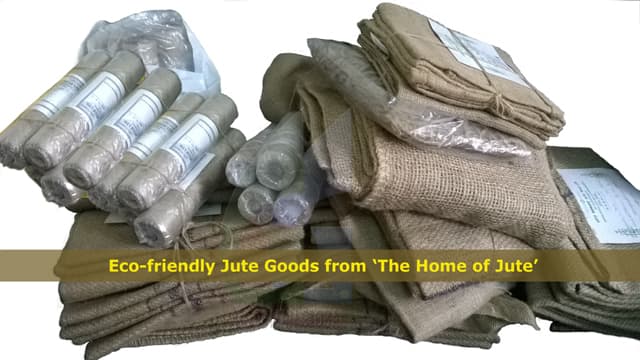
How it works
Laid over bare soil, the open mesh holds the surface in place against wind and water, shades the ground so it retains moisture and seed, and lets grass and planting grow up through the weave. As the fibre breaks down it becomes mulch, adding organic matter back into the ground and leaving no plastic behind — the decisive difference from synthetic matting, which persists indefinitely and sheds microplastics.
Applications
- Slope & embankment stabilisation — Holds soil against wind and water while vegetation establishes.
- Riverbank & shoreline protection — Open weave resists scour and lets planting root through.
- Road & rail cuttings — Standard civil-engineering erosion control on new cuttings.
- Landscaping & turf establishment — Shades the soil, cuts evaporation and helps seed germinate.
- Land reclamation & revegetation — Adds organic matter to poor ground as it breaks down.
- Agriculture & horticulture — Mulch matting for moisture retention and weed suppression.
Typical specifications
| Specification | Typical range |
|---|---|
| Fabric weight | 500–900 g/m² |
| Mesh / openness | Open weave, for water flow and plant growth |
| Roll width | 1–4 m (1.22 m and 2 m standard) |
| Roll length | 25–100 m |
| Life span | 6–24 months depending on site conditions |
| Packing | Rolls or bales, industrial volumes |
Exact specifications are produced to your project requirement. Send the weight, width, roll length and quantity and we will quote against it — or describe the site and we will propose a construction.
Ordering & export
Geotextile ships FOB Chittagong with full export documentation, in rolls or bales, FCL or LCL. Production is typically 4–6 weeks after specification is agreed. See the FOB Chittagong guide for what is and is not included, and the buyer FAQ for MOQ, samples and payment.
Frequently asked questions
What is jute geotextile?
Jute geotextile — also called soil saver matting — is an open-weave matting woven from jute yarn and supplied in rolls. Laid over bare soil it stabilises the surface, retains moisture and seed, then biodegrades into mulch that enriches the ground, typically within 6 to 24 months depending on site conditions.
What weights and widths are available?
500–900 g/m² in roll widths from 1 to 4 m — 1.22 m and 2 m are the most commonly specified — with roll lengths from 25 to 100 m. Exact specifications are produced to your project requirement — send the weight, width and quantity you need and we will quote against it.
How long does jute geotextile take to decompose?
Typically 6 to 24 months, which is long enough to stabilise the soil and establish vegetation. It then biodegrades into mulch, leaving no plastic or microplastic residue behind.
Why choose jute geotextile over synthetic matting?
Synthetic geotextiles persist indefinitely and shed microplastics into the soil. Jute does the stabilising job during the critical establishment period and then disappears, returning organic matter to the ground — which is decisive for environmentally sensitive projects and clients with sustainability mandates.
Do you export jute geotextile in bulk?
Yes. We manufacture to specification and export industrial volumes in rolls or bales, FOB Chittagong, with full export documentation.
Related
- Jute geo-textile / soil saver matting (JDP-077) — product detail
- Jute geotextile for erosion control: specifications & applications — the full technical guide
- Jute yarn, hessian & fabric range — rope, twine, hessian and carpet backing
- Jute fabric specifications: yarn counts, GSM & weave